
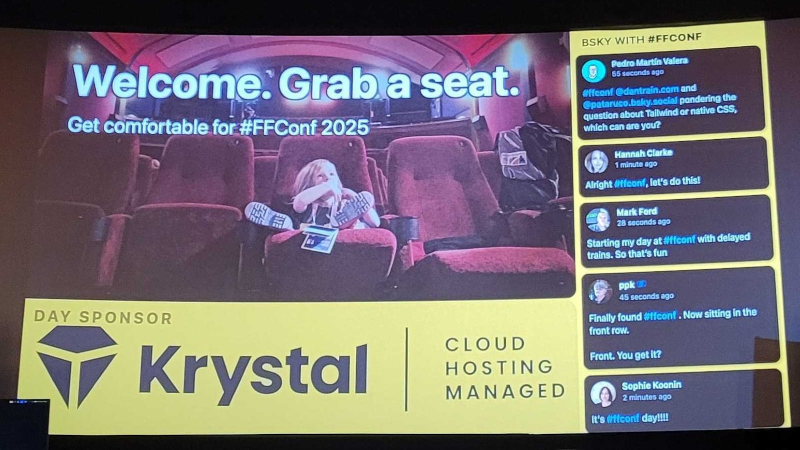
On Friday, 14 November, Krystal was proud to be a sponsor of FFConf, a one-day conference in Brighton focusing on the future of the web, whatever that might be.
Along with our remit to help make the web the better place, we were also able to be sponsors for inclusion scholarships, giving people who are part of underrepresented groups in tech a chance to see the talks, network with other people who are also interested in tech, and generally enjoy being a part of this inclusive and powerful event.

We took notes for all the talks to find out what’s important for the future of the tech industry, from the use of AI to how unconscious bias can affect representation to web components to the sheer joy that can be found on the web through fandom.
Before the talks began, the organiser, Remy Sharp, asked the audience: "Have a question in your head — what is one thing I can take away from today and apply on Monday?"
And with that in mind, here are our notes on the talks given.
Hellen Ward — Bias in Our Products: The Case for Diversity in Tech
Hellen started by talking about her background, how she was an administrative assistant, learned to code through Codebar Brighton, and became a software engineer. She pointed out that many women and minority groups do come from different backgrounds, and that job descriptions are often written with a certain candidate in mind — someone with a computer science degree and focuses on computers not just as a job but also as a hobby.
Which might explain the statistics on women and ethnic minorities in the tech industry. Detailed statistics are difficult to pin down, but there are a few rough answers.
An all-party parliamentary group focusing on STEM in 2019 gave the statistic of women making up 27% of the workforce in STEM fields, including healthcare and STEM educators. Engineering UK puts out a report every year focusing on Office of National Statistics data, and their most recent data says 15.7%. And for ethnic minorities in STEM, Engineering UK states 13.6%.
This is shocking, as many women and ethnic minorities played an incredibly important role in the early days of computing, including:
- Ada Lovelace, who wrote the first computer program
- The ENIAC Six, including Betty Snyder and Jean Jennings Bartik
- Grace Hopper
- Clarence "Skip" Ellis
- Margaret Hamilton
- Mary Jackson
- Evelyn Boyd Grenville
As computers became a source of money, the field stopped being seen as a low-status job, with women and minorities being pushed out. Which is how we have the "nerdy developer" stereotype.
Why does this matter? Many people might believe that, as long as the product’s being built, does it matter who is building it. But the lack of diversity leads to two important issues: unconscious bias and data gaps.
Hellen brought up several examples of these issues, from a soap dispenser failing to work for a black man’s hand, Facebook’s advertising algorithms skewing job listings by gender, and facial recognition technology being skewed towards the middle-aged white man.
These problems are also prevalent in AI, and Hellen had examples focusing on women’s healthcare. Historically, the male body has been seen as the default, with students learning "anatomy" and "women’s anatomy" and healthcare trials not including women of childbearing age until the 1990s. AI models now miss liver disease in women twice as much as it misses it in men, and other tools downplay women’s health needs in social care, risking people not getting the help they need.
Hellen did end on a hopeful note, however, pointing out that AI was getting better, but that there still needs to be better training and management to ensure the models are more diverse.
Chetan Padia — Powerless by Design
Chetan started by describing how he began as an Android developer, and how much he loved working with Google products. But Google would keep coming up with great products and then just shut them down, and Chetan wondered why he would keep using these products and why Google would keep doing this.
He then wondered about how Google’s revenue is $102.136 billion and yet it didn’t cost him a thing to use. Google pays $20 billion to be the default search for iPhones and also funds most of Mozilla by being the default search engine there.
Where is all their money coming from and how do we fit into this?
Most of Google’s revenue comes from ads, most of which are on their search results. And the advertising is targeted to you by the data collected through the many Google applications you use. Whether that’s Analytics, Gmail, Google Maps, Android, Sign In With Google, or Widevine (the DRM system used for playing copyrighted and encrypted content on the web, such as Spotify, BBC iPlayer, Netflix, Udemy, and more), they have your details.
He then discussed the Meta pixel, which tells you everything about the people visiting your site, allowing you to target your ads even more. AdGuard states that, out of all user traffic, 7.84% is ad tracking, and it doesn’t matter if you don’t "use" Facebook, the trackers are still there.
And now with AI, people aren’t visiting websites any more. LLMS are providing answers, but as we’ve seen before, there’s so much information out there about us, and we can be microtargeted and nudged towards making decisions we might not have made before. How are these products biased? What is the impact? Are we complicit in the removal of checks and balances by using the platforms these billionaires give us?
Chetan then listed what we can do to cut down on our impact:
- Refuse to give websites and applications unnecessary permissions
- Turn off autoplay and suggestions
- Think about where you get your news from
- Choose the web version instead of the application
- Use adblockers
- Look into different web browsers — not just Firefox, but Orion and Ladybird
- Use search engines like Duck Duck Go, Kagi and Mojeek
- Check out other applications, such as Signal, IMAP email, VPNs, ente Photos, OpenStreetMap and OsmAnd, and Hugging Face and Ollama
- Donate to open-source projects and if you use it, pay for it
He also recommended talking about this to your friends, families, and colleagues. Discuss these things, discuss these ideas, and get involved.
He finished by recommending that all of us try something new.
Hannah Clarke — An Uncomfortable Place
Hannah is a UI Engineer in a Design System Team, working for a SaaS provider that has a large number of products, especially acquired products. Acquired products mean different tech stacks and frameworks, and the challenge faced by Design System Team was providing consistent component libraries across these frameworks.
Web components were a potential solution. Components are web platform APIs that allow you to create custom, accountable, and encapsulated HTML tags. With Shadow DOM, custom elements, HTML templates, and ES modules, web components would give framework-agnostic components built to use existing browser standards.
However, the implementation wasn’t as simple as it could have been, with React not listening to custom events. Wrappers were needed to work with React, and a wrapper needed a library. Libraries weren’t absolutely needed, but they reduce writing boilerplate, giving you Shadow DOM control, and give you other helpful tools. Her team used Stencil, which included TypeScript support, works well with React, Angular, and Vue, and was built for component libraries and design systems.
While the System Team could see the potential of Stencil’s output, the other developers were a bit wary. The team needed to write in a new script that would take the Stencil output and provide everything the developers needed, making the web components more React-friendly and ready to be used.
She finished by pointing out that "Web components aren't the thing. They’re the thing that gets us to the thing."
Sergès Goma — You're in a Code Cult (and that's ok)
Sergès started with a quiz, making the audience aware of the strong and competitive allegiances people can have for their frameworks and tools — and that as part of this, we are all in a cult. When she started working in tech, she discovered how many cults there were in the industry, with everyone asking her "What is your stack?"
She then referred to Leviathan by Thomas Hobbes, focusing on how society is created. We, as humans, decided to stop fighting because we wanted to live longer and healthier while submitting to a higher authority. We decided it was better to be under an authority so that we could live collectively together. These were how societies of developers also worked — we were all coding alone and decided we should come together. We became a cult.
The sense of belonging not only meets one of Maslow’s Hierarchy of Needs (the need for belonging and a sense of connection), but is also key to making people more resilient, as well as giving them better job satisfaction and wellbeing, as seen in IEEE Software’s "Guidelines for Cultivating a Sense of Belonging to Reduce Developer Burnout" by Trinkenreich, Gerosa, Sarma, and Steinmacher.
But there are problems with these cults. There’s gatekeeping, elitism, and imposter syndrome. It brings in collective narcissism, which can bring in intergroup aggressions. That, by taking pride in your identity while also still being insecure deep down, you snap when anyone dares criticise the identity.
Developers are in a cult focused on our jobs and tools, which is a rare thing, and that instead of embracing collective narcissism, we should focus on sharing cool ideas, tools, and problem solving methods. That the passion and constructive criticism we can provide drive progress and innovation within the industry.
That we should say "Yes to cults!"
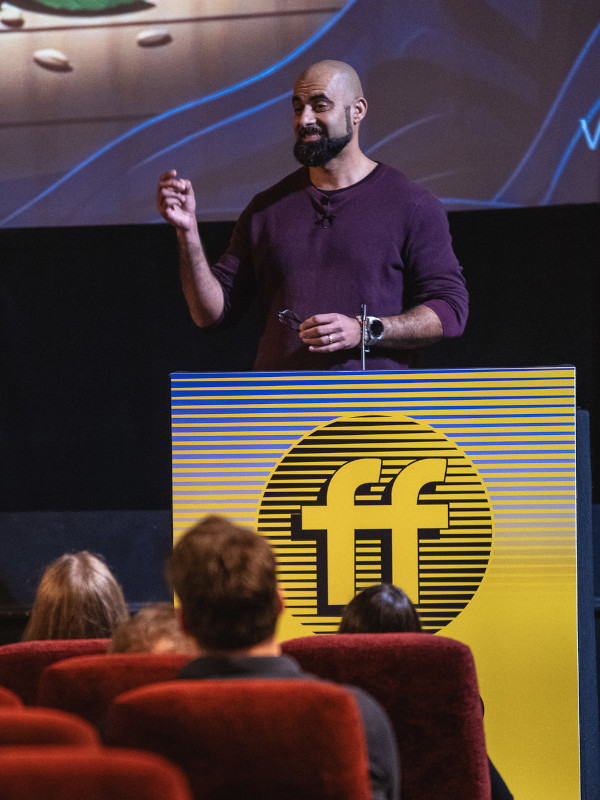
Asim Hussain — Don't Be An Idiot
Asim started by talking about the Greater Eleusinian Mysteries in Athens, a sacred cult that lasted approximately 2,000 years and included many great thinkers of the day. He discussed the drink that was taken during the rituals, and how researchers think it might have been ergot contamination on barley, which would provide a hallucinogenic experience.
He then discussed the theories surrounding consciousness, and how DMT, another hallucinogen, is naturally occurring in the body, and may bring forth the collective consciousness that is possible in the theory of Analytic Idealism, where a single universal consciousness buds into individual consciousnesses, with a deep connection between all living things.
Combining the shared experience of the Eleusinian Mysteries and the subsequent rise of Athenian democracy, Asim explored the idea of participatory democracy, where there were no representatives, no political class, just a council of 500 who would set the agenda.
Whereas now we have representative democracy, where citizens elect others to deliberate on their behalf and the agenda is set not by the citizens, but by the political class.
He suggested the use of Generative Social Choice, using AI to parse the voices of the people, letting people decide their preferences, and then the people can vote on their preferences. By taking free-form voices, stories, and conversations, distilling them and setting the agenda based on genuine public preference, this model removes the power of agenda-setting from the political class and places it into the system itself, providing more nuanced and honest feedback.
While there are still problems, including AI bias, manipulation, populism, demagoguery, and propaganda, it could still be a better system than what we have now.
"I believe that democracy was a message from our higher consciousness," he stated, and that we need to be aware of public affairs, and not the ancient Greek "idios", a private person uninterested in politics.
Eda Eren & Jessica Rose — Forgetting Machines: AI Coding Tools and Skill
Eda and Jessica focused on the current hype over AI replacing developers, and focused on the potential impact of AI coding tools on developer skills.
They explained how LLMs produce code — they collect the datasets, models are trained on that data, users query the models, and with that query, the model produces output based on what the model has most often "seen" in contexts it "thinks" are connected to the query.
In other words, "it’s a very fancy autocorrect".
This goes against how people learn, where new neural pathways are built and existing pathways are strengthened. There’s declarative knowledge (knowing the information) and procedural knowledge (the ability to take that information and do things with it). And with AI tools, they can cut through the paths and go directly to the source.
AI tools stop us from procedural learning, taking away the higher-level reasoning needed. You can know the words, but you can’t construct the sentences.
It will also have an effect on your team and your projects. The skillset of your team is only the skillsets of your team members, and by using AI tools, that is a major knowledge gap lurking underneath the surface, as well as producing code that does not take into account your users’ needs, your research, or your use cases.
Code you did not write is code you do not understand. And you can’t maintain code you do not understand.
This is also an industry issue. The skills you have together in your team bring in the skills the industry uses. We’ll not only see a gap that will be visible for beginners, but it will also further divide who has access to skills, since AI does cost. It also does not solve the existing problem of sourcing future senior developers — only making it worse. Not to mention that, as individuals, we learn best when we’re not scared. We work best when we have steady employment, when we’re not freaked out, when we have space to learn.
But we’re not doomed — we can push back.
We can be more involved in the intentional aspect of learning, being more present in it rather than just blissfully enjoying the abstraction these tools provide.
We can focus on self-guided learning: - Take formal courses or learning support programs - Do side projects — silly or serious - Read. It might be declarative knowledge, but you can apply that knowledge elsewhere. - Keep a learning journal - Do daily challenges and exercises like exercism or Code Wars - Write blog posts about things that you are learning as notes to your future self - If you are using these tools, talk through what your generated code is doing, to better understand the code
If you’re a manager or a decision maker for your team:
- Build learning time into your timelines
- Run code reviews that check for understanding
- Build skills sharing in to team processes
- Be judicious and thoughtful about where and how these tools are supplied, encouraged, and evaluated for your team members
- Have training and support that reinforce skills development
And what can we do for the industry?
- Focus on others
- Teach and mentor other people
- Share your own knowledge
- Support emergent talent
- Reinforce healthy working patterns and processes, so that there is time to learn.
Surya Rose — Six to Sixteen: A Child's Programming Journey
Surya has been coming to FFConf with his dad for several years, starting at 8 years old, and always dreamed of giving a talk there. He just never thought it would actually happen.
As a "professional 16-year-old", Surya talked about his programming journey, where, at age 6, he asked his dad to teach him how to code
His first real project was a game blending elements together — potio.nz. His dad wrote the code, explaining what the different bits were and how they worked together. Surya learned about data-driven development, how to save a file, how to navigate between windows, and simple shell commands.
From that, his dad decided to start doing programming classes for other kids as well, and he solidified his programming skills through helping and teaching the other kids. Different people think in different ways, and he learned how to adapt his explanations into ways that made it easier for other people to understand, changing his own ideas on what was happening.
At 10, he made a two-dimensional survival game, which taught him about SVGs, input detection, and collisions. And then he discovered Minecraft.
Minecraft wasn’t just a fun game for him, he learned about shell commands and datapacks — a single file that lets you write shell commands into one script, essentially creating a virtual machine in a virtual machine in a virtual machine.
Through datapack jams, events, his own YouTube channel, and his podcast, he learned how to solve problems, build scripts, and how to interact with a larger online community. He had learned JavaScript, but he wanted to learn other languages as well, as well as creating his own.
At 13, he created his first language, using parser combinators. HIs second language was based on building a custom scripting language in TypeScript, using the Lexer.
He discovered that he liked static typing, a Go-style interface, and algebraic data types, so his third language was built in Go. He needed to see how a real-world compiler code-base was organised, so he began looking at the Rust code base. But doing pull requests wasn’t satisfying.
He then discovered Gleam, a small language with a much smaller codebase. Written in Rust and compiles to Erlang and JavaScript, Gleam was a friendly language with a friendly fanbase, and worked well for building type-safe systems that scale. He kept contributing to the Gleam compiler, and was asked to join the core team in 2024. And now, at 16, he’s sponsored on GitHub to work on Gleam.
The main takeaway of his talk was that everyone should start by making something useless that you enjoy, and eventually it will turn into something useful that everyone can benefit from.
Sacha Judd — The Good Internet: How Fandom Can Reclaim the Web
Sacha started her talk going back to the beginning of the Internet, when the experience was chaotic and exciting — a non-linear exploration, where clicking links was like stepping onto a street where every house was painted a different colour.
And what kept people coming back online was finding other people interested in the same things they were. She pointed out her first introduction to the Internet: transformative fandom, especially alt.tv.x-files on Usenet.
Many of the Internet conventions we take for granted came from those early communities, including FAQs, user-created content, community-driven self-governing, and decentralisation. It was not a utopia, being small, very homogenous, and difficult to get around, but it was fun.
However, there was tension between commercial content producers and the fans. The producers wanted to leverage the Internet, pushing the traffic to their own sites, while the fans wanted to do whatever they wanted with the characters and universes, with free speech and freedom to assemble. Fandom has a long and proud history of exploring relationships never seen on page or screen, and advertisers, who fund the producers, have only recently even allowed the slightest explicit queer content, and definitely still hate infringement of intellectual property.
As the web evolved through to Yahoo!, mailing lists, Geocities, and building your own websites, fans maintained their focus on DIY, peer-to-peer sharing, keeping control over our own spaces, and ensuring permanence. As Web 2.0 rolled out, focusing on user-generated content and interoperability, fandom was there, including Livejournal and Tumblr.
But the transgressive nature of fanworks were always going to be at odds with platforms that relied on advertising. Livejournal was preyed upon by organisations that didn’t just target fandom, but also queer artists, survivor groups, and book clubs. Tumblr was taken from app stores until it awkwardly imposed rules that resulted in the loss of users. As corporations began to look at ways to monetise fan experiences, the fandom pushed back, creating Archive of Our Own, a collective open-source project focusing on providing the permanence needed for fandoms.
And as Kyle Chayka talks about in Filterworld: How Algorithms Flattened Culture, the corporate landlords are doing it on purpose — making everything into an all-in-one app where you can’t leave the walled garden you’re in, you have to follow the rules set down by the advertisers.
So how can we change that?
We need to take back control of our scroll. Own your algorithm. Work out what can be good for intentional groups — there are currently no good tools for community, but plenty of tools for communication, and we’re going to need new tools to help us build healthy online neighbourhoods. They’ll need:
- Persistent archives
- Transparent governance
- Layered privacy
- Federation and portability
If the first generation gave us villages, and the second gave us unlivable mega cities, the third needs to give us neighbourhoods, small, liveable, human-space spaces.
We need to re-weird the web. Sacha gave examples such as Caps Lock Is On, The Closest Pandas, Clickens, Traffic Cam Photobooth, and the strange world of 715-999-7483.com. She linked to a map of a rabbit hole she went down, showing you that the new web needs to be about getting active again, about encouraging you to go places and work with the garage door up.
That we all need to:
- Build something
- Teach someone
- Take back control
- Explore outside the walls
And, together, we can make things better.

What did we take away from the conference?
We come from a long line of enthusiastic and innovative creators, but we need to step out of the walled gardens built by corporations and think about how much data we’re actually giving away. AI can help us, but it can also affect our learning. And the kids are going to be all right.
Were you at FFConf and forgot to say hi? You can still talk to us on Facebook, LinkedIn, Instagram, BlueSky, or Mastodon!
(Photos by Trys Mudford for FFConf. and Kate.)
Share this article
About the author

Kate B
I'm Kate, and I'm one of the Senior Marketing Managers here at Krystal. I'm a transplanted Southern Californian who likes bad pop culture, the Internet, and talking everyone's ears off about web hosting. Howdy!